
Mercury Retrograde Without the Fear: Three Things to Revisit

Mercury retrograde is back for its final run of 2026. By now you’ve likely seen a fair amount of social media posts, emails in your inbox, and short videos about what it is and why it’s a problem.
It seems like the first thing that happens as Mercury retrograde comes around is everyone hits the panic button. Don’t make big plans! Don’t sign anything important! Don’t start new projects! A lot of people make it seem like for the roughly three weeks of the retrograde you need to hide in your house with everything turned off.
That might sound like a lot, and I’ll admit that’s the extreme end of what happens. But ask yourself, “Have I ever blamed Mercury retrograde for something that didn’t go as planned or for problems that popped up?”
I’m guessing you have. I know I have! For many of us who pay attention to spiritual and planetary energies, it becomes a convenient explanation for tricky situations.
But we can focus so much on the negative associations of Mercury retrograde that we become almost hyperaware of anything that could go wrong. If we shift our thinking and perception a little, we might find this isn’t a time to fear at all.
What Mercury retrograde actually means
Mercury retrograde describes a period when Mercury appears to move backward in the sky from our perspective on Earth. The planet hasn’t actually reversed its orbit.
This apparent reversal happens because Earth and Mercury orbit the Sun at different speeds and distances. Mercury travels around the Sun faster than we do. As our positions change, our view of Mercury against the distant stars changes too, making it appear to slow down, move backward, and eventually move forward again.
If you’ve ever watched another car seem to move backward as you pass it, you’ve experienced how relative motion can change what you see. The planetary geometry is more complicated, but the useful point is the same: something can appear to move backward while continuing forward.
In astrology, Mercury is associated with communication, thinking, information, technology, and travel. Its retrograde periods are commonly interpreted as opportunities to review, reconsider, and revisit those areas of life.
Somewhere along the way, that gets translated into “your technology will betray you, your ex will return, and every decision you make will be wrong.”
You can see how the panic starts.
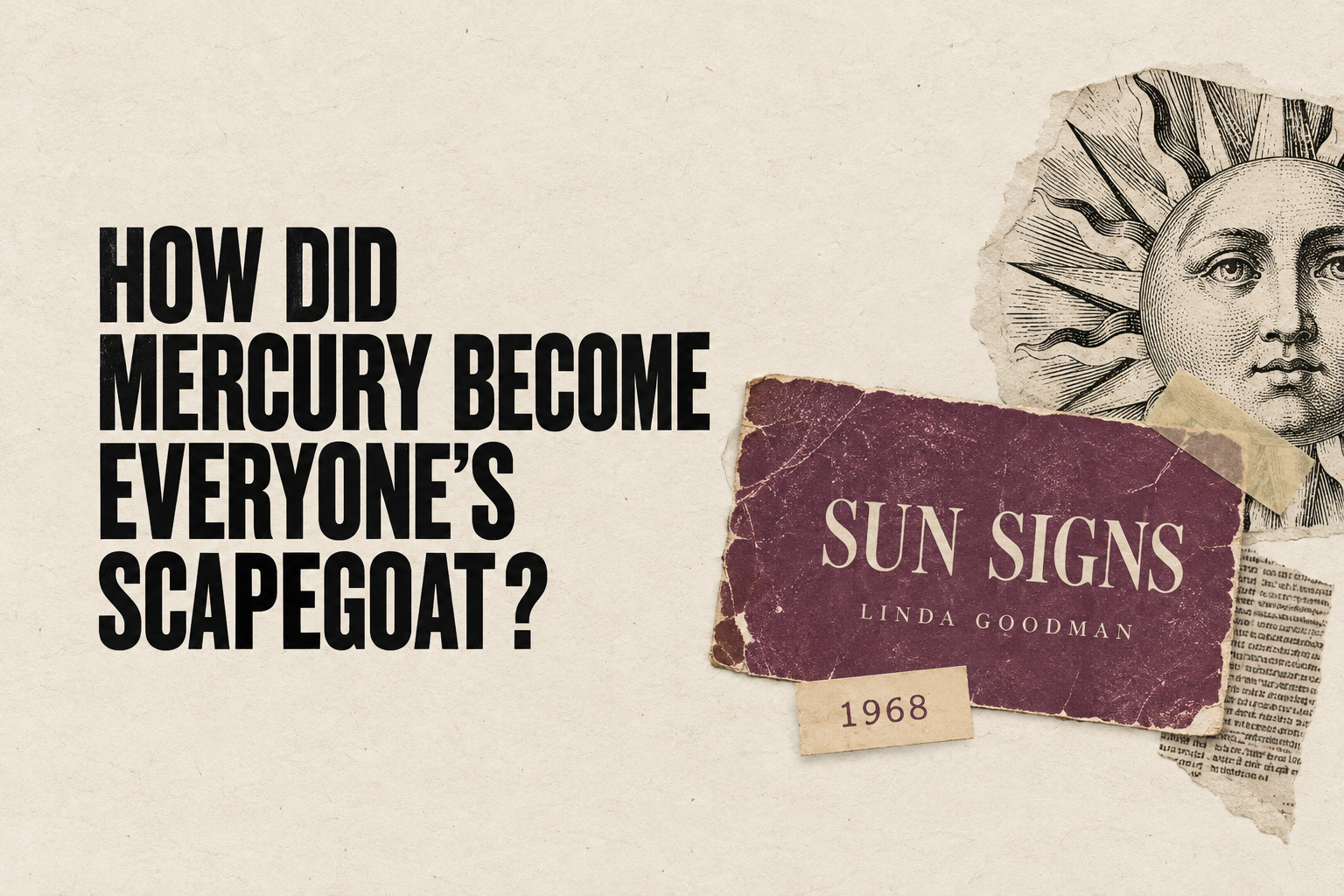
Concerns about retrograde planets existed long before social media. In horary astrology, which uses a chart cast for the time a specific question is asked rather than using someone’s birth date and natal chart. Retrograde motion could affect how an astrologer interpreted the situation, and in some extreme cases might even determine if an astrologer would answer the question at all. Some believed their own readings were impacted by Mercury retrograde. Mercury being retrograde wasn’t automatically a prediction that everything would go wrong, but it was common that it would be a sign for caution.
During the 1930s, as newspaper horoscopes began to grow in popularity, astrologers had to start finding ways to take complex astrological concepts and make them short, easily digestible, and relatable for the common reader. This is where we start to see Mercury retrograde take on this negative connotation with the general public.
Linda Goodman’s Sun Signs, published in 1968, became a staple in the New Age community during the 1970s. Goodman played a major role in bringing astrology to people who weren’t interested in studying charts or learning technical terminology. Her writing was personal, emotional, funny, and relatable. Readers could recognize themselves, their partners, their children, and even their bosses in her descriptions. Astrology became something they could connect to their everyday lives.
That approach mattered. People could use astrology to explore questions about relationships, personality, work, and the ways they interacted with others. Goodman helped make those connections accessible to a much wider audience, and her influence carried into the astrology boom of the 1970s.
This is an important part of the background to today’s Mercury retrograde conversations. Once astrology becomes a familiar way to interpret everyday experiences, planetary explanations become easier to reach for when something feels confusing or difficult. There can be comfort in that. A difficult interaction or frustrating day can feel less personal when you believe there’s a larger pattern involved. Goodman popularized the idea of this being a time for RE-evaluation, RE-examining, and RE-doing.
But this is also where I think we can slide from seeking understanding into finding a convenient explanation. “What might this help me understand?” becomes “This happened because of the planets.” With Mercury associated with communication and travel, you can see how retrograde becomes an easy suspect when a conversation goes badly or plans fall apart.
Goodman’s contribution to popular astrology is a key part of this story, but the broader warnings about Mercury retrograde developed over time. Historian of astrology Nicholas Campion describes astrologers in the 1980s expanding older, more specific interpretations of retrograde into something people applied much more widely.
Then the internet and social media gave those ideas a much larger audience. The late 2000s seemed to be a time when the fear aspect of Mercury retrograde really became popular. You no longer needed to consult an astrologer or follow an astrology calendar to know Mercury was retrograde. The dates, warnings, and explanations could appear right in your feed, alongside jokes blaming Mercury for whatever had gone wrong that day.
Much like the Telephone Game, each person sharing the message can add a little more flavor. A suggestion to take extra care becomes a warning to expect problems. Eventually, people who have little interest in astrology still know Mercury retrograde as the time when everything supposedly goes wrong.
That’s why this history matters. The warnings we hear today have been shaped by generations of interpretation, popular writing, and the ways we share information. We can appreciate Goodman’s role in making astrology accessible while still questioning what those messages have become.
And we can decide how much of that fear we want to carry into our own practice.
1. Revisit the story you’re telling yourself
Let’s say you send someone a message and don’t hear back.
On an ordinary Tuesday, you might assume they’re busy. During Mercury retrograde, after a week of warnings about communication disasters, you might start wondering whether they misunderstood you. You reread your message six times and send another one to explain. Now you’re stressed about a problem you don’t even know exists.
The unanswered message is real. The meaning you’ve attached to it is still an assumption.
This is where I think we need to be more thoughtful about how we discuss energy, attention, and manifestation. What we expect can influence what we notice and how we respond. If we’re watching for trouble, an ordinary inconvenience can feel like confirmation that everything is going wrong. Once we’ve noticed one example, it’s easy to start looking for more.
That doesn’t mean an anxious thought caused your car trouble or that you manifested a missed flight. Being worried isn’t a spell, and you don’t need to police every thought that passes through your head.
But there’s a difference between acknowledging a frustrating situation and deciding it’s the beginning of three weeks of disasters. That interpretation can affect what you do next, including whether you ask a useful question or react to something you’ve assumed.
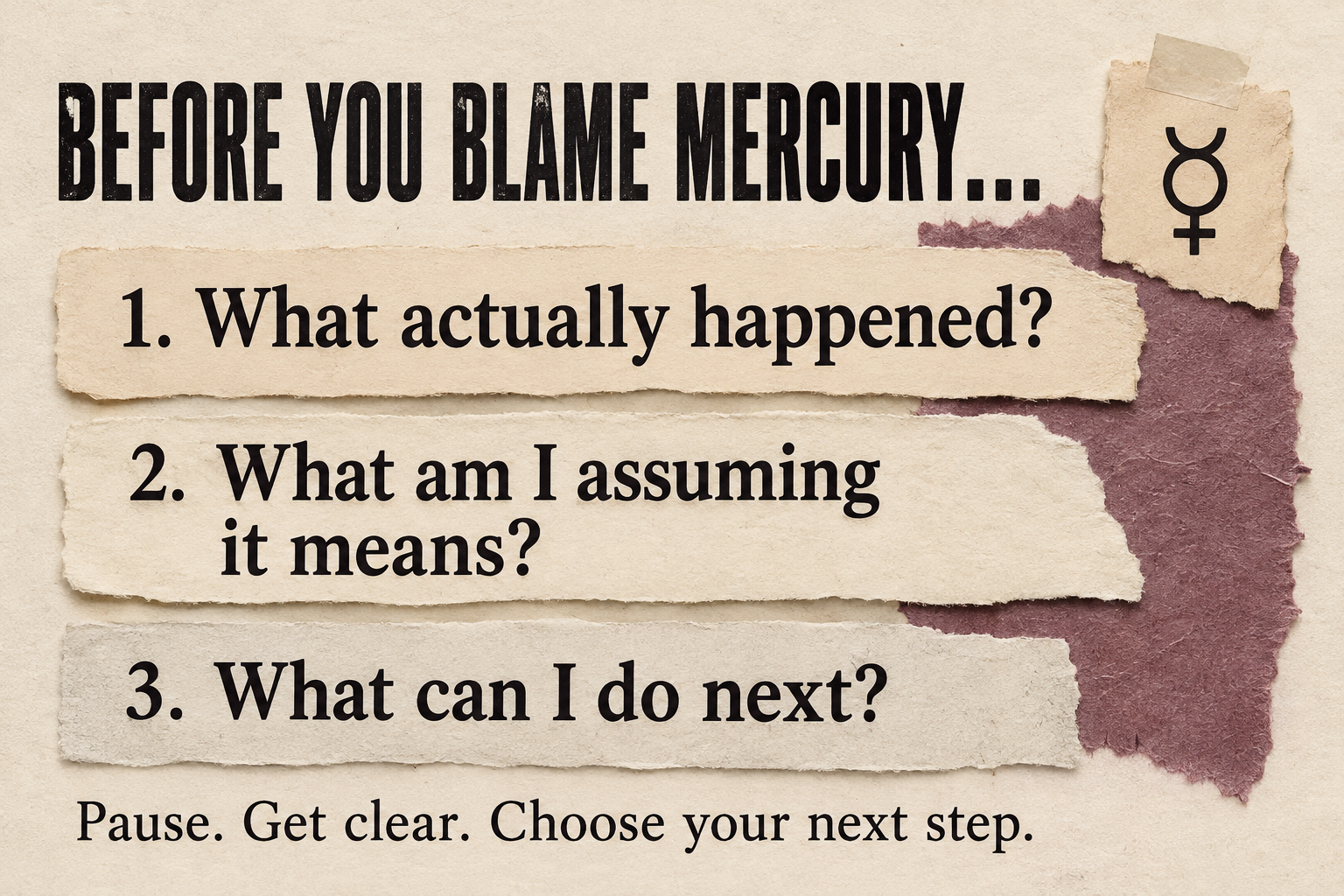
When something goes sideways, pause and ask:
What actually happened?
What am I assuming it means?
What can I do with the information I have?
“My appointment was canceled” gives you a situation to address. “Mercury is ruining everything” leaves you waiting for a planet to get its shit together.
You might still be annoyed about the cancellation. Fair enough. But you can reschedule an appointment without making it evidence that the rest of your month is doomed.
2. Revisit what actually needs your attention
The idea of reviewing things during retrograde can be useful. Most of us have something that would benefit from a second look, whether that’s an agreement we rushed into, a conversation we’ve been avoiding, or an unfinished project buried under six newer ideas and a pile of laundry.
You don’t have to turn this into an audit of your entire existence. Pick one thing that matters to you right now.
If communication is on your mind, clarify an agreement instead of assuming everyone understands it the same way. If technology worries you, back up the files you keep meaning to back up. If a project feels stuck, look at where you stopped and decide whether you want to continue.
These actions address an actual need. Retrograde can be the reminder that gets you to do them, and you’ll still benefit from having done them once Mercury turns direct.
The same approach applies to decisions. Life doesn’t stop because Mercury appears to move backward. People still need to accept jobs, find housing, make plans, and handle responsibilities. Sometimes an opportunity comes with a deadline that doesn’t care what’s happening astrologically.
Read the details, ask questions, and get appropriate advice when you need it. Give yourself time to consider a decision where you can. You can take planetary timing into account in your practice while also considering the circumstances in front of you.
Try this: Write down one thing you want to revisit and the next action it requires. “Sort out my entire business” is a project. “Reread the email and clarify the deadline” is a step you can take.
The point is to leave yourself with something manageable, rather than another reason to feel overwhelmed.
3. Revisit what you want your magick to support
Before reaching for a Mercury retrograde protection spell, get specific about what you need.
Are you worried about a difficult conversation? Trying to make a decision? Feeling scattered because you have too much going on? Each of those gives you a different purpose for your working.
“Protect me from everything that could possibly go wrong” is a broad assignment. An intention for clear communication or thoughtful decisions gives you something more focused to work with. It also helps you choose tools and actions that make sense for the situation.
You can still cast spells during Mercury retrograde. If planetary timing is part of your practice, consider it alongside your purpose, circumstances, and the traditions you follow. You don’t have to adopt a blanket rule from someone whose practice may be very different from yours.
For a simple working, sit with your journal and write down the situation that’s taking up the most space in your head. Underneath it, finish these three sentences:
What I know is…
What I need to clarify is…
The action I can take is…
Read your answers aloud. Hearing the words can help you notice where you’re being clear and where you’re filling in gaps with assumptions.
Then choose a short intention that fits the situation. You might focus on listening carefully, asking directly, or giving yourself time before responding.
For this working, you could choose a grey or silver candle to use for setting your intentions. These are colors associated with Mercury but if another color feels more fitting, use what feels right.
Hold the unlit candle while focusing on your intention, then place it in a suitable holder and light it. Spend a few moments considering how you want to approach the situation and what following through will look like. Extinguish it when you’re finished, or let it continue burning while you can safely attend it.
Then take the action you identified in your journal.
If your working is for clear communication, ask the question you’ve been avoiding. If it’s for discernment, give yourself time to examine the options. Your magick has a purpose, and your actions give you a way to carry that purpose into everyday life.
You don’t have to spend retrograde waiting for trouble
You’re allowed to notice astrological timing without treating it as a threat. You’re also allowed to feel frustrated when something goes wrong without searching for a spiritual reason behind every inconvenience.
And you’re allowed to have a perfectly decent few weeks while Mercury is retrograde.
Use this time to revisit something that matters to you. Ask a better question, finish something you still want to finish, or make a practice more useful to the life you’re actually living.
We spend enough energy dealing with real challenges. We don’t need to borrow trouble from somebody else’s horoscope.
What’s one thing you’d like to revisit during this retrograde?
